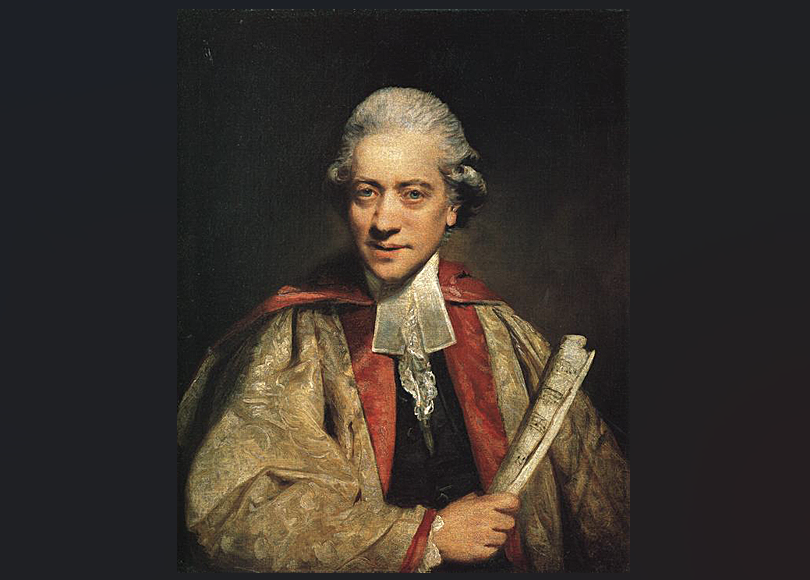
Artistic Director John Moore looks forward to the next Shropshire Music Trust concert celebrating the tercentenary of Shrewsbury musicologist and composer Dr Charles Burney - with Ex Cathedra at St Chad's Church on Friday, June 5th. The concert will be preceded at 6.30pm by a 30-minute conversation about Dr Burney with Ex Cathedra’s director, Jeffrey Skidmore. John will also be reading excerpts from Burney's writings during the evening.
When Charles Burney was born in Raven Street, Shrewsbury, in 1726, the great JS Bach was just 41 years old. And when Charles passed away at the ripe old age of 88 in 1814, Beethoven still had 13 years left to live. Burney's life spanned some of the greatest years of musical and technological invention and development the world had yet seen, and he was determined to record, experience and write about it as much as he could.
Burney was the fourth of six children of James MacBurney, a musician, dancer and portrait painter, and his second wife Ann. The young Burney was educated for a while at Shrewsbury School, now the town’s library, and later at the King’s school Chester. Returning to Shrewsbury aged 15, Charles continued his musical studies under his half-brother James Burney, organist of St Mary’s Church, before becoming a pupil of the great Dr Thomas Arne, composer of Rule Britannia and much more, in London for three years.
Burney wrote for the theatre in London under the pseudonym The Temple of Apollo, working for the Scottish Music Publisher and composer James Oswald.
“I then a pupil of Mr Arne, was desired by some of the Covent Garden singers with whom I was acquainted, and who knew I was a bit of a composer, to set parts to the old tune for the NEW HOUSE, as it was then called, which I did”
Burney also played during his time in London for the great Handel himself, and made his living from being a jobbing organist, harpsichordist and composer. With operas, plays needing incidental music, the great musical pageants in the Vauxhall pleasure gardens and elsewhere, London was awash with musical possibilities, which must have been manna from heaven for the young, ambitious Burney.
He and the family moved to North Norfolk for several years to Kings Lynn where Burney started to formulate his ideas for a great history of Music in the English Language, and during which time he married his second wife after the death of his first wife Esther, with whom he had six children including Frances (Fanny), who was to become one of the foremost literary figures of the day herself.
For his history of music, Burney also wanted to collect details of as he put it, “The Present State of Music” in France, Germany and Italy. He therefore embarked in 1770 on the first of his two major tours armed with many letters of introduction, and proceed to visit the cultural capitals of Europe at the time, immersing himself in the musical life of these centres, and meeting and interviewing in the process as many significant artistic and important persona as he could. On the 5th Junes he arrives in Dover bound for France, only to find he had forgotten his sword, 'At this time the necessary passport of a gentleman on the continent'. He gives us lovely snapshots of the conditions he endured on his travels by mostly coach once on the continent. En route to Paris he writes of a stay in an Inn outside the gates of St Omer:
“After my sea-sickness and total depletion on stale mackerel, a salad with rancid oil and an omlet made with addled eggs….and the next morning some poor coffee and milk with bad bread and butter…..”
In Paris he attended one of the famous Concert Spirituelle performances where, he says, a Madame Delcambre: “screamed out….with all the power of lungs she could muster and a chorus surpassed, in clamour, all the noises I had ever heard of in my life”.
There is no doubt that travelling was a test of endurance too. He says this of his carriage experiences en route to Milan:
“ There was such a number of legs in close contact with each other that mine, for the first time in my life, became so swelled by the confinement as was both painful and alarming!”
In Venice he gives us a wonderful picture of the inattentiveness of the audiences:
“Every box is furnished with a complete room, with a fireplace in it and all conveniences for refreshments and cards. In the fourth row is a Pharo table, on each side of the house, which is used during performances of the opera. The noise here during the performance was abominable!”
During his two major tours abroad, Burney was able to meet some of the most important and significant figures of his day. Mozart, CPE Bach, Rousseau, Diderot, Voltaire, Quantz, Metestasio, Gluck, Frederick the Great of Prussia, and many, many more. Accounts of both tours were subsequently published, and both proved to be best sellers and helps establish Burney as a man of letters. The great Dr Johnson pronounced Burney the greatest travel writer of the age.
Charles also worked tirelessly on his great opus, the History of music, and competed fiercely with his archrival Hawkins to get the first such history into print.
Burney was a huge admirer of Franz Joseph Haydn, the first truly great composer of the Classical period, and he was thrilled when Haydn came to London at the behest of the promoter, Salomon, in 1791. Burney says this of Hadyn:
“The admirable and matchless Hadyn, from whose productions I have received more pleasure late in my life, when tired of most other music, then I ever received in the most ignorant and rapturous part of my youth, when everything was new, and the disposition to be pleased, undiminished by criticism of satiety”
The University on Oxford honours Burney with an Honorary degree on the 23rd June in 1769, and Joshua Reynolds painted a fine portrait of him in his academic robes, looking every bit the English Haydn, a man he so admires and with whom he had communicated since 1763.
His admiration for Hadyn can be summed up in his reaction to hearing the celebrated London Symphonies by Haydn: “ ….such as were never heard before, of any mortal’s production: of what Apollo and the Muses compose or perform we can only judge by such production as these”
It is through Burney’s diaries, his published journals and his volumes of the History of music that we get such a wonderful snapshot of eighteenth century culture and life. His experiences on his tours bring together such a range of music by both Baroque and Classical composers. His friendship with Haydn and the great astronomer and musician Herschel meant that he had access to the greatest men and women of his age, including the celebrated Blue Stocking figure of Mrs Thrale in London, whose soirees and cultivated circle of the great and good included Burney, who lived for a while almost as a member of the Thrale family.
When Haydn came to publish his great Oratorio Creation, it was Burney who achieved more support for publication than anyone else:
“I procured for him more subscribers for that sublime effort of genius, the Creation, than all his other friends, whether at home or abroad put together”
Ex Cathedra’s Grand Tour programme will take us along with Burney on his travels to hear some of the music he heard himself, by composers he met and by men he knew personally. He is truly one of the great sons of Shrewsbury, and in celebrating his 300th anniversary with this concerts and other events, we can pay tribute to this remarkable man of letters and so much more.
Ex Cathedra - A European Grand Tour Programme to celebrate the 300th anniversary of the birth of Dr Charles Burney: Friday, June 5th at St Chad's Church, Shrewsbury. Tickets £11-£22 HERE


